Product information
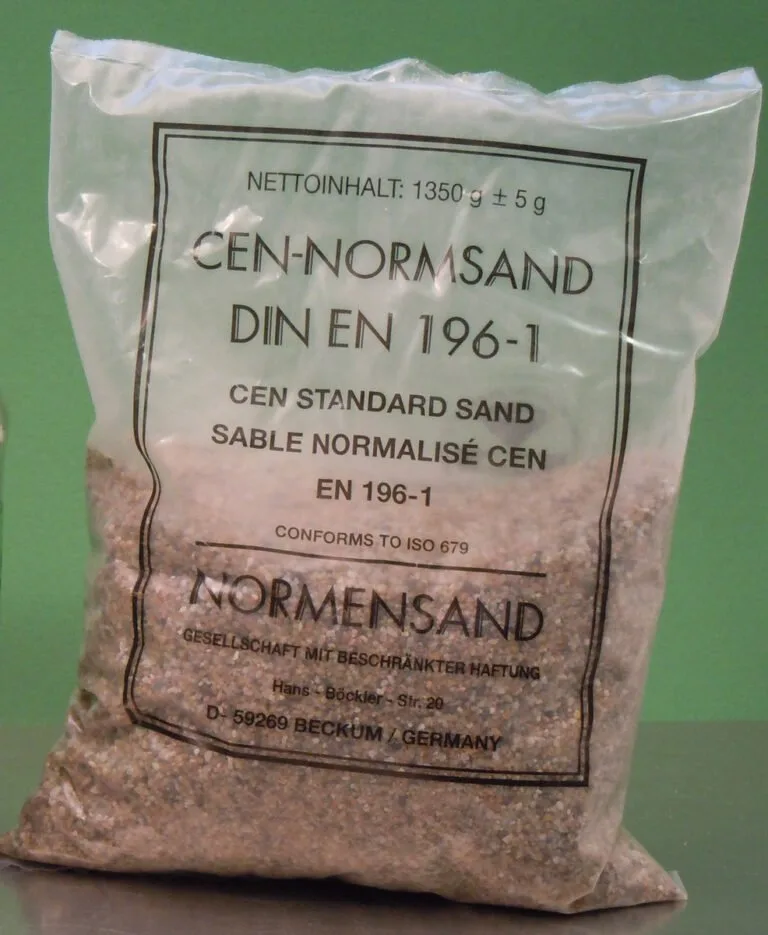
Standard sand according to DIN EN 196-1 is characterized primarily by a specific grain size distribution. The grain sizes range from 0.08 to 2.00 millimeters. Their ratio can be found in the table below. Furthermore, the maximum moisture content of the sand is 0.2 percent. It is packaged in bags weighing 1,350 (± 5) grams. By adding 450 (± 2) grams of cement and 225 (± 1) grams of water, three mortar prisms for testing the standard compressive strength are produced from one bag of standard sand.
Specification- Standard: Paper bag with 36 portion bags
- Portion sachets: 1350 ± 5 g
Particle size distribution range according to DIN EN 196-1
| Sieve (mm) | lower limit | Interval mean | upper limit |
|---|---|---|---|
| 2.00 | 0 | 0 | 0 |
| 1.60 | 2 | 7 | 12 |
| 1.00 | 28 | 33 | 38 |
| 0.50 | 62 | 67 | 72 |
| 0.16 | 82 | 87 | 92 |
| 0.08 | 98 | 99 | 100 |
Production
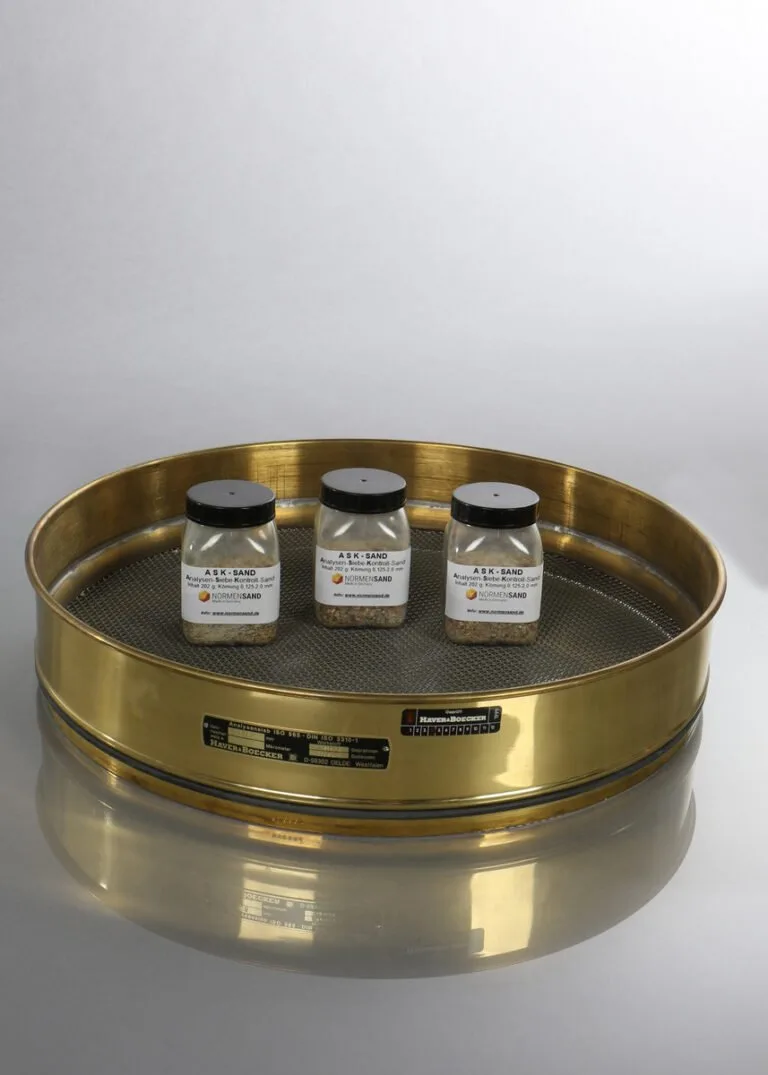
Since sand with the particle size distribution required by the DIN EN 196-1 standard does not occur naturally, standard sand must be artificially produced. For this purpose, natural, quartz-rich sands are sieved in several stages to obtain individual fractions of the different particle sizes. The sand fractions are then remixed in defined ratios. The greatest challenge lies in maintaining the required precision and consistency during sieving and subsequent dosing over a very long period. As part of quality control, manufacturers of standard sand are therefore obligated to check and document their production at least once a day to ensure compliance with the required particle size distribution (grading curve). Simultaneously, monthly compressive strength tests (28-day mortar compressive strength) are required. Furthermore, an annual audit is conducted by the responsible certification body.
Plan your Physical testing enquiry
For CEN standard sand according to DIN EN 196 Part 1, include the intended application and any essential configuration or compatibility requirements.
- Material, specimen dimensions, preparation and the test procedure you intend to use.
- Property being measured, expected range, accuracy requirements and compatible fixtures.
- Test frequency, conditioning requirements, available utilities and result reporting.
Explore Physical testing equipment and selection questions ↗