Product information
For commonly used mesh sizes of analytical sieves (2.0 – 1.0 – 0.5 – 0.25 – 0.125 mm), a control material was characterized a few years ago through a round-robin study involving 147 national and international participating laboratories. As a consequence, DAP (Deutsches Akkreditierungssystem Prüfwesen GmbH, Berlin), which has since merged into DAkkS, published a technical information sheet on the application of traceability for analytical sieves. This technical information sheet stated that, between scheduled calibration dates, the suitability of an analytical sieve for use can be considered given if the cumulative sieve residue determined with ASK sand in the sieve test is within defined values.
In addition to the prescribed regular visual and intermediate inspections, ASK sand is suitable as a simple functional test within the framework of regular quality assurance.
Specifications-
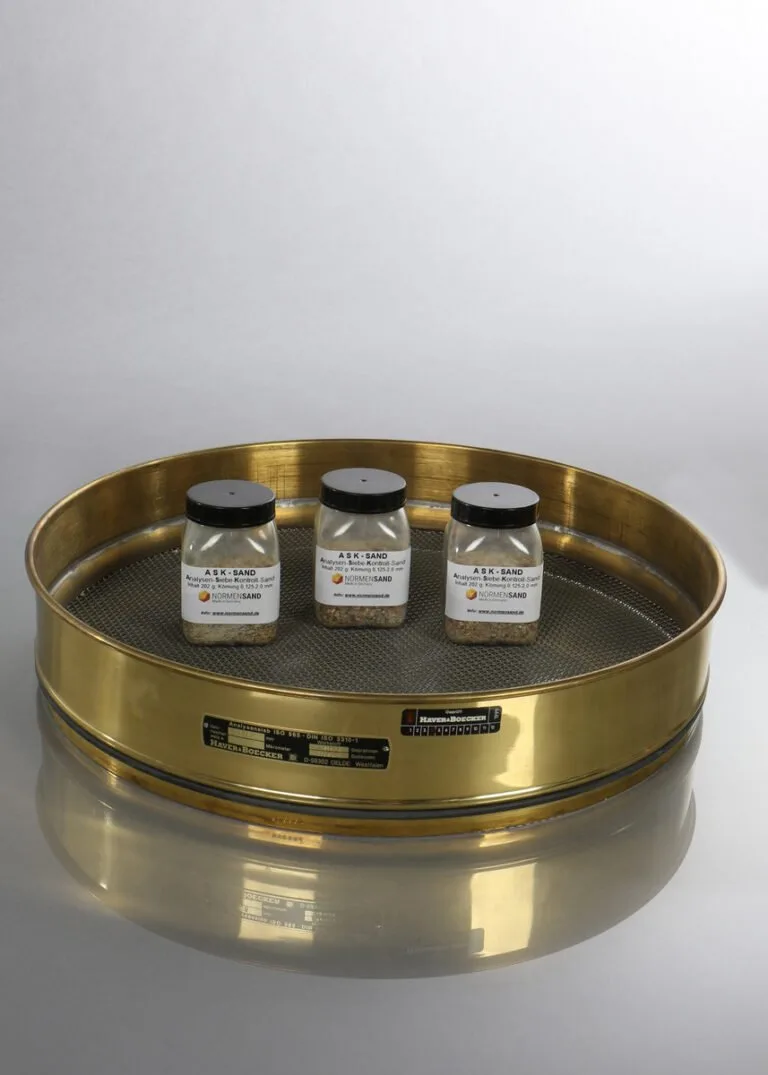
- Unit of 3 PE jars, each 202 g
- Grain size: 0.125 – 2.00 mm
- Suitable for single use only
| Defined area according to the DAP information sheet within which the cumulative sieve residue must lie. | ||||||
|---|---|---|---|---|---|---|
| Mesh size in mm | 2.0 | 1.0 | 0.5 | 0.25 | 0.125 | < 0.125 |
| Minimum value in % of the total quantity | 10.9 | 37.7 | 65.8 | 81.1 | 91.9 | 98.8 |
| Maximum value in % of the total quantity | 12.3 | 40.1 | 69.0 | 83.7 | 94.3 | 100.0 |
Plan your Physical testing enquiry
For Analytical sieves – control sand, include the intended application and any essential configuration or compatibility requirements.
- Material, specimen dimensions, preparation and the test procedure you intend to use.
- Property being measured, expected range, accuracy requirements and compatible fixtures.
- Test frequency, conditioning requirements, available utilities and result reporting.
Explore Physical testing equipment and selection questions ↗